
◆ AI AT WORK · Jobs
California sends a two-part workplace AI ban to Newsom
AB 1883 cleared the legislature on August 30 and goes to Newsom unsigned. Two specific categories of workplace AI tool are prohibited; which one a product falls under determines how much of the emotion-AI market the bill would reach.

Chandni Melwani
Founder & Editor
Aug 30, 2026 · 2 MIN READ

The News
California's legislature sent AB 1883 to Governor Gavin Newsom on August 30, 2026, the last day of the legislative session, after the Assembly concurred in Senate amendments. The bill passed the Senate on August 28 by 28 to 9, and cleared the Assembly on its initial pass on May 27 by 52 to 12. Newsom has not signed it. AB 1883 would prohibit covered employers from using workplace surveillance tools that incorporate emotion recognition technology or that collect neural data from workers. The bill defines neural data as information generated by measuring the activity of a worker's central or peripheral nervous system that is not inferred from nonneural information. A separate prohibition covers emotion recognition technology, defined in the bill as AI that analyzes a worker's biometric data and physical state (including facial expressions, vocal intonation, gait, heart rate and skin conductance) to infer, predict, or modify a worker's internal emotional and behavioral state. Employers who violate the provisions face a civil penalty of up to $500 per violation, enforced by the labor commissioner or a public prosecutor. Covered employers include private businesses, labor contractors, state agencies, the University of California, California State University, community college districts, cities including charter cities, counties and school districts. The bill exempts operations related to aircraft, national security, military, space and defense product development where use is reasonably necessary under federal statute, regulation or binding contract, and tools used solely to ensure worker safety that do not meet the prohibited specifications.
Know More
- — Neural data, verbatim: the bill defines it as information generated by measuring the activity of a worker's central or peripheral nervous system that is not inferred from nonneural information.
- — Emotion recognition technology: defined as AI that analyzes biometric data and physical state (including facial expressions, vocal intonation, gait, heart rate and skin conductance) to infer, predict, or modify a worker's internal emotional and behavioral state. All three verbs and the word 'internal' are in the statutory text and each of them does work.
- — The penalty: up to $500 per violation, enforced by the state labor commissioner or a public prosecutor.
- — Coverage is wide: private employers, labor contractors, state agencies, UC, CSU, community college districts, cities including charter cities, counties and school districts.
- — Not yet signed: Newsom vetoed SB 7, the No Robo Bosses Act, on October 13, 2025, citing it as overly broad. AB 1883 is narrower in scope.
- — Effective date: not stated in the bill text reviewed. California bills typically take effect January 1 of the following year, but that default has not been confirmed for this bill.
California’s legislature passed AB 1883 on August 30, 2026, the final day of its session, sending a ban on two categories of workplace AI tool to Governor Gavin Newsom. The Senate passed it 28 to 9 on August 28; the Assembly concurred August 30. Newsom has not signed it, and nothing below is law unless he does. The fullest public argument over the bill is on the record and on video: the Senate privacy committee’s June 29 hearing, where its author, Assemblymember Isaac Bryan, presented it, the California Federation of Labor Unions spoke as a cosponsor, and the California Chamber of Commerce opposed it. That recording runs about twenty minutes and is hosted on a player that cannot be embedded here.
The bill’s first prohibition covers emotion recognition technology, defined as AI that analyzes facial expressions, vocal intonation, gait, heart rate or skin conductance to infer, predict, or modify a worker’s internal emotional and behavioral state. The third verb matters as much as the other two: a tool that nudges a call-center agent toward a scripted cheerfulness is covered by “modify” even if it never labels the agent’s mood. The second prohibition covers neural data, meaning direct measurement of central or peripheral nervous system activity, with a clause that limits its scope sharply: “that is not inferred from nonneural information.” A webcam produces pixels. A microphone captures air pressure. Both generate nonneural information, so inferences drawn from them fall outside the neural data definition.
A tool that reads mood from video or audio cannot escape liability by pointing to the neural data carve-out. It faces the emotion recognition ban on its own terms, because it analyzes biometric data and physical state to produce an inference about a worker’s internal emotional state. Employers running sentiment analysis on call-center audio get no safe harbor from the definition they read first.
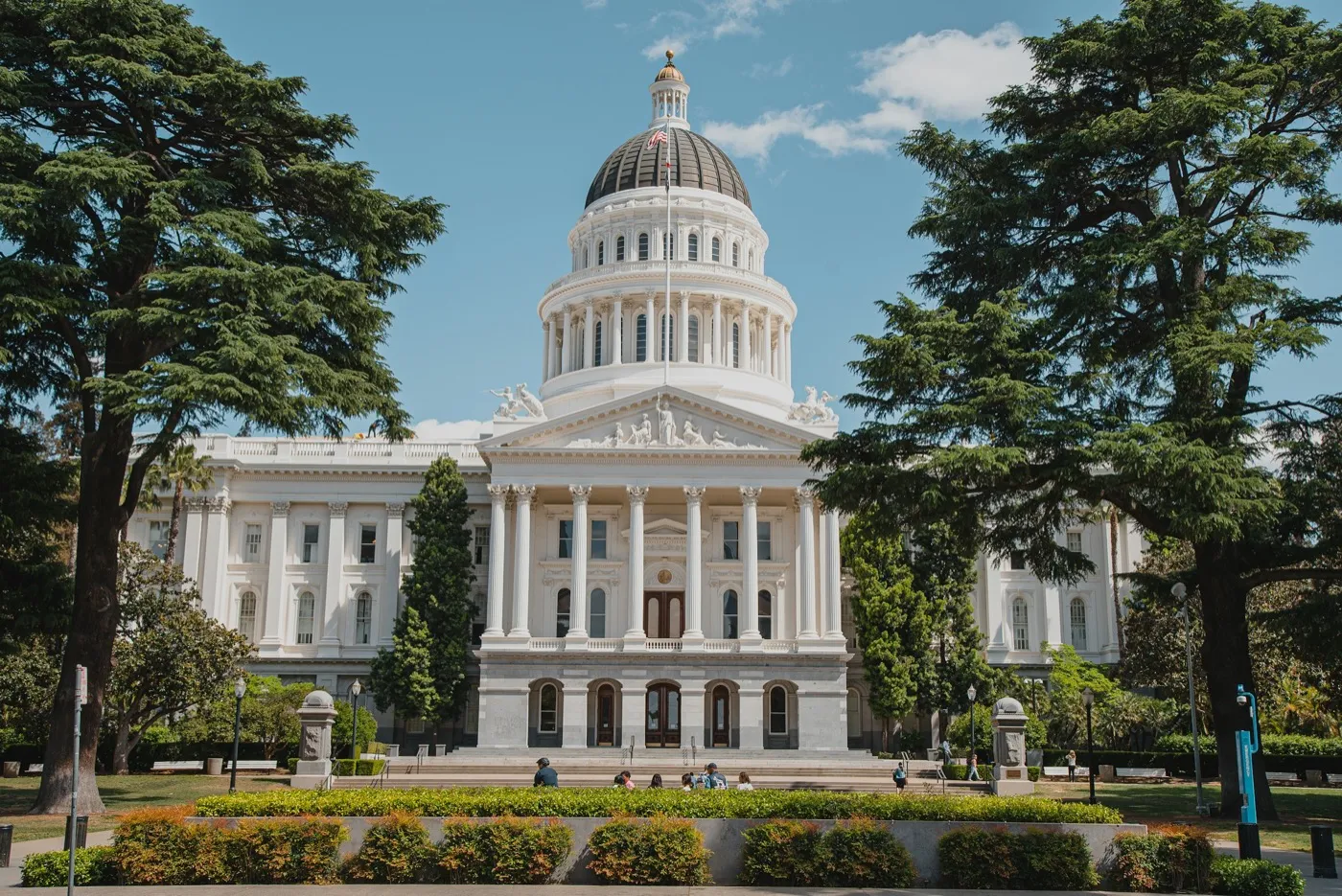
The California State Capitol in Sacramento, where the Senate passed AB 1883 on August 28 and the Assembly concurred on August 30. The photograph is of the building, not of either vote. Photo: Josh Hild / Unsplash
Newsom vetoed SB 7 (the No Robo Bosses Act) on October 13, 2025, calling it overly broad. AB 1883 is narrower, targeting two specific tool categories rather than all automated employment decisions. Whether that narrowness makes it more signable is a call Newsom has not made. California in 2026 has already seen newsroom protests over undisclosed AI deployments and federal data showing most US workers already use AI on the job. The tools are in the workplace; the governor now has the bill.
Related
Frequently Asked Questions
Does this cover tools that read emotions from a webcam or voice analysis?
Not exactly. The bill has two separate prohibitions. The emotion recognition ban covers tools that analyze facial expressions, vocal intonation, gait, heart rate and skin conductance to infer, predict, or modify a worker's internal emotional and behavioral state. The neural data ban covers only direct measurement of the central or peripheral nervous system, and its definition explicitly carves out information inferred from nonneural signals. A webcam produces pixels; a microphone captures air pressure. Both generate nonneural information, so both fall outside the neural data prohibition and squarely inside the emotion recognition one.
What did Newsom do with the last major AI employment bill?
Newsom vetoed SB 7, the No Robo Bosses Act, on October 13, 2025, calling it unfocused and overly broad. That bill would have required human oversight for any automated personnel decision, a wider scope than AB 1883, which targets two specific categories of tool. Whether the narrower focus makes this bill more signable is a judgment call Newsom has not yet made.
Are there exceptions?
The bill has safety and defense carve-outs. Tools used solely to ensure worker safety, provided they do not meet the prohibited specifications, are exempt. Operations involving aircraft, national security, military, space or defense product development are also exempt where the use is reasonably necessary under federal statute, regulation or binding contract.
Sources
- AB 1883 bill text, California Legislative Information: definitions, prohibitions and exemptions
- AB 1883 bill history, California Legislative Information: Senate vote recorded 08/28/26 as Ayes 28, Noes 9, and the August 30 Assembly concurrence
- HR Dive, "California ban on workplace AI emotion surveillance heads to Newsom's desk" (August 31, 2026)
- Bloomberg Law, "California Passes Bill to Ban AI Tracking of Worker Neural Data" (August 30, 2026): Newsom veto precedent

Chandni Melwani
Chandni Melwani is the founder and editor of New in AI, covering AI agents, M&A, and enterprise adoption. She holds a Master's in Management of Artificial Intelligence from Queen's University and brings a practitioner's perspective from her work in Data and AI leadership.
Follow ↗AI at Work Briefing
Get the five-beat briefing before the market opens.
One email. Frontier labs, AI at work, e-commerce, and the capital crossing borders — decoded daily.
No spam. Unsubscribe anytime.
More from AI at Work
Tools
OpenAI proposes cutting off Cursor's model access on November 12
OpenAI says it will wind down the contract that supplies its models to the AI code editor Cursor, proposing a shutoff on November 12, 2026, after SpaceX bought Cursor's maker. Teams standardised on Cursor now have a dated deadline.

Chandni Melwani · US · Aug 28, 2026
Enterprise
Google capped console purchases of Gemini Enterprise Standard and Plus at 25 seats. Past that, you talk to sales.
Growing a Gemini Enterprise Standard or Plus subscription past 25 seats now runs through a sales representative rather than the console. The invoiced-billing gate also sits in front of Google's AI coding tools.

Chandni Melwani · Aug 25, 2026
Tools
Slack moved AI coding work out of the IDE and into a channel your colleagues can read
Slack launched Slack Code on August 20, giving coding agents their own channels where planning, diffs and approvals happen in front of the whole team.

Chandni Melwani · Aug 24, 2026